Sánchez declares war to save Private García Ortiz
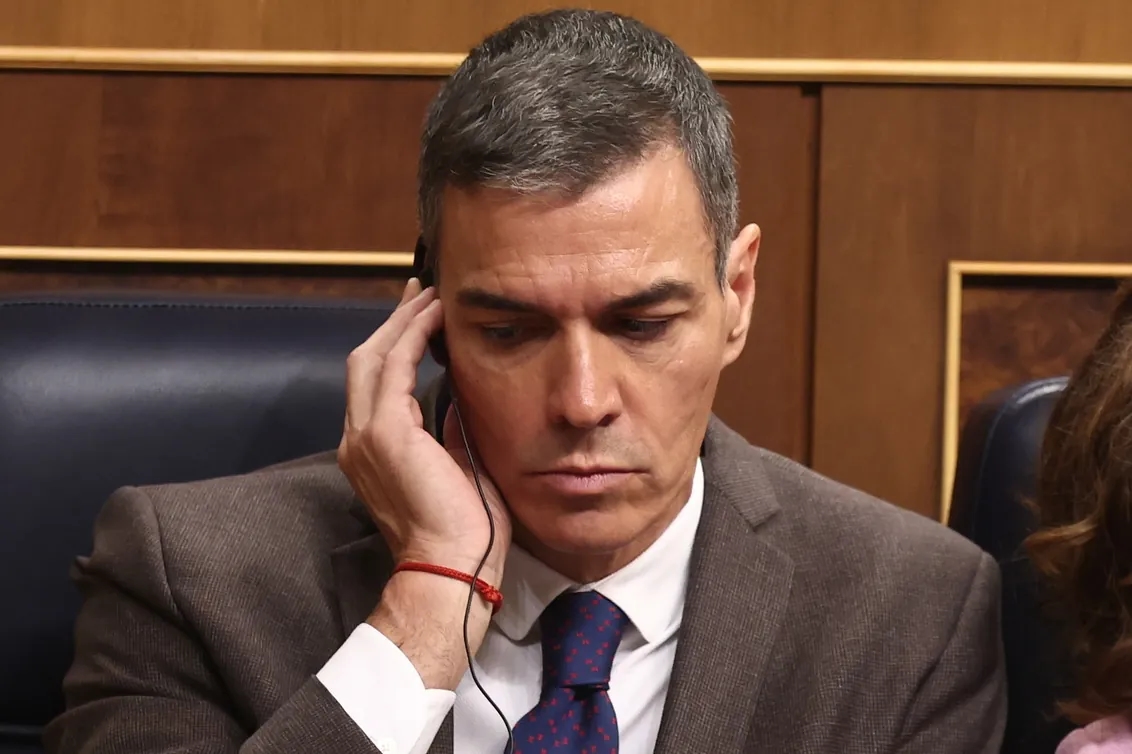
The president says the state attorney general is "innocent" and is pressuring the Supreme Court to close the case.
The Prime Minister, Pedro Sánchez , has once again shown contempt for Montesquieu and the principle of separation of powers that should govern a state governed by the rule of law by declaring in an interview with 'El País' that the Attorney General, Álvaro García Ortiz , is "innocent." For the Prime Minister to pass judgment in advance in a case currently before the Supreme Court is an unprecedented anomaly. It not only exposes the inconsistency of the leader's democratic principles but also puts the judges of the Criminal Chamber of the Supreme Court, who are responsible for evaluating the evidence and delivering their verdict, in a precarious position.
Sánchez's intervention in the trial of the Attorney General is much more than an opinion. It is a threat that conditions the entire process and foreshadows an all-out offensive against the Supreme Court should it fail to agree with his assessment and ultimately convict his trusted ally.
Sánchez's gamble is frightening. In his eagerness to raise the bar for confrontation ever higher, the president has drawn all his loyalists into the battle to save Attorney General García Ortiz. For now, this includes his ministers and allied media outlets, who have rushed to declare the Attorney General's innocence based on the exculpatory statements, lacking any supporting evidence, of some of his journalists. Faced with this general legal hysteria fueled by the government, the association of prosecutors yesterday accused Sánchez of "pressuring and delegitimizing" the courts, while the leader of the People's Party (PP), Alberto Núñez Feijóo , blamed him for "undermining judicial independence."
The harassment isn't limited to judges. The government is using these same media outlets to cast suspicion on some of the witnesses who aren't favorable to them in the trial, such as the chief prosecutor of Madrid, Almudena Lastra , whom they have recently tried to implicate in the leak of the infamous secret email containing the personal information of Alberto González Amador , Isabel Díaz Ayuso 's boyfriend. In an act of utter shamelessness, Lastra, who was the one who warned the Attorney General against circulating the emails, is now being singled out as a possible leaker by some of these same media outlets, in an attempt to exonerate the Attorney General. The Supreme Court justices will have to consider their options because the dirty tricks are blatant. The difference is that they know García Ortiz deleted evidence, and Lastra didn't. And nobody deletes evidence of their innocence.
Executive interference in the judiciary has become the norm this legislative term. The lack of discretion with which Sánchez and his subordinates issue certificates of innocence and offer assessments of judges' work from the press podium raises suspicions about the president. Would someone with nothing to hide muddy the waters like this to erode the judges' credibility? Is he protecting himself with this vehement defense of García Ortiz?
Since his wife, his brother, his closest government collaborators, and his Attorney General have been formally charged with clear evidence, Pedro Sánchez and his associates, instead of offering explanations, have opted for a strategy of obstruction. The president and many of his ministers claim that a minority of judges are "playing politics" and that there are politicians trying to administer justice. With the first assertion, and without naming names or accusing anyone, they cast doubt on the entire judiciary. And when he says that the Attorney General is "innocent," as he has done, Sánchez presents himself as an example of what he says should not be done.
The president's attacks come amidst an offensive by his minister , Félix Bolaños, to reform the Criminal Procedure Law (Lecrim), so that prosecutors, not judges, will now be in charge of investigations and will order the judicial police what should and should not be investigated. Given his personal circumstances, this maneuver seems particularly jarring. The argument that it is to adapt the procedure to what happens in Europe is untenable. In other countries, the Public Prosecutor's Office enjoys complete independence from the Government, something that is not the case here, as has been evident throughout this period.
Sánchez has made no secret of his attempts to force judges and prosecutors to obey him. His televised address, in which he asked himself, "Who does the Public Prosecutor's Office depend on?", implying that it was under his control, has already become legendary. The appointment of his Minister of Justice, Dolores Delgado , as Attorney General, and her subsequent replacement by the now-indicted Álvaro García Ortiz, are just the tip of the iceberg in what amounts to a relentless attack on the independence of the judiciary.

Expansion