Iran reaps a peace dividend - but can we really expect it to remain peaceful? asks ALEX BRUMMER
Updated:
Football fever, by-elections and central bank decisions have obscured the baffling outcomes of President Trump’s accord with Iran.
Instead of reflecting the military advantage won because of the US-Israel bombing campaign, designed to remove Tehran’s terror threat to the Middle East, Iran may emerge economically triumphant.
Before the war there was evidence that financial sanctions and largely disabled oil exports to the West had brought the mullah-led nation to its knees.
The currency was in free fall, inflation rampant and protesters on the streets. Now there is an economic lifeline.
As a reward for political normalcy, including keeping the Strait of Hormuz freely open to traffic, Iran has been granted the right to sell oil and gas.
Before the conflict it was restricted to shipping to Asian markets and covert sales. There is also the frightening prospect of Iran regaining access to $100billion of frozen assets and the restoration of up to $60billion a year of income from selling oil.
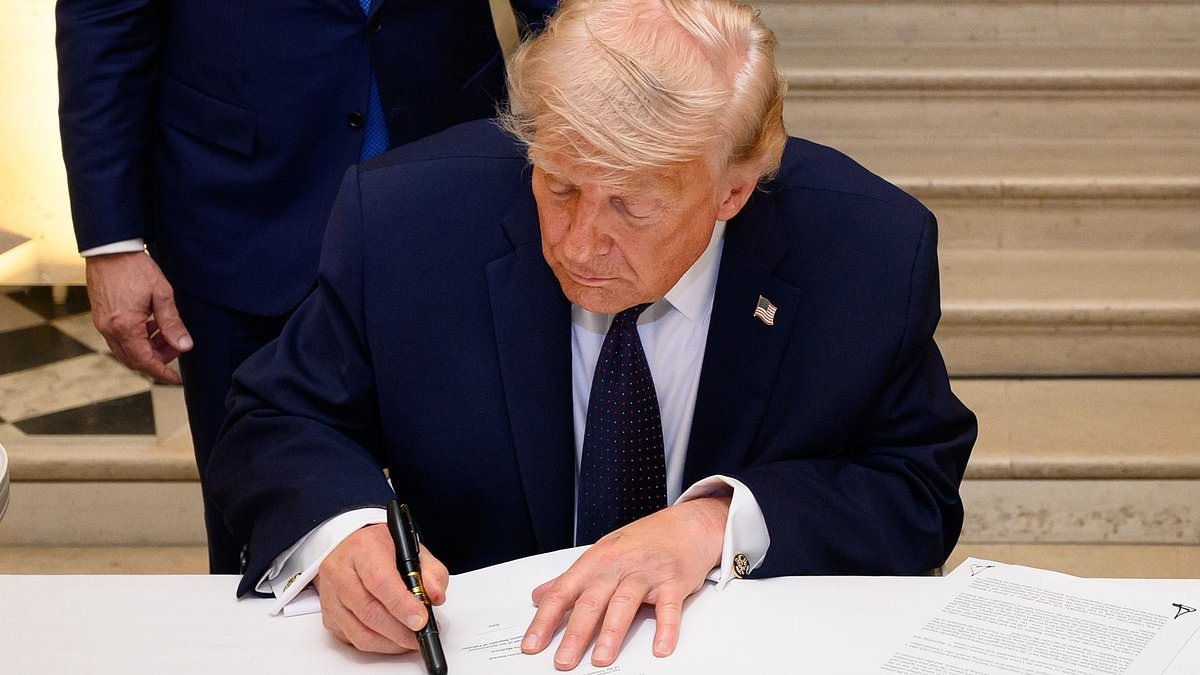
Shaky truce: President Trump signs his controversial peace deal with Iran following more than three months of conflict
Indeed, when and if a final deal is concluded, there is even the possibility of a $300billion international fund being established for reconstruction.
As much as Iran’s neighbours may be pleased that attacks are halted, the prospect of an unfriendly regime in Tehran regaining access to funds to renew offensive weapons stocks and fund proxies Hezbollah, the Houthis and Hamas is frankly terrifying – especially for Israel.
There is a view that US President Donald Trump had no option.
As America’s summer driving season gets into full swing, Americans see access to cheap fuel as a God-given right. Elevated prices have been moderated by the administration using strategic reserves.
These are running low and the prospect of a Republican wipeout in November’s mid-term elections is imaginable. The biggest mystery is around the proposed $300billion reconstruction fund.
Trump insists there will not be a cent of US money. The fund, if established, is contingent on a final settlement.
The idea is that the money would come from corporations across the globe keen to break back into a market of 90m people with ample energy resources.
Restoration of Iran to the global stage after 47 years of hostility to the West might appear a golden scenario.
Iran is not Venezuela and its Revolutionary Guard Corps is not going to engage in an unconditional peace. Frightening!
Events in the Gulf would appear to justify the Bank of England’s wait-and-see stance. The 7-2 vote to hold rates at 3.75 per cent might look sensible given the fall in energy prices and softness of the UK economy.
Raising rates now, as political uncertainty ramps up, could be seen as a hammer blow to output, consumer and business confidence, and the housing market.
Yet history tells us that once the inflationary genie is out of the jar, it is difficult to squeeze it back.
This is especially true during Labour governments when proclivity to give in to the trade unions on wage deals, nationalisation of utilities and spending is intense.
The dissidents on the Bank’s Monetary Policy Committee, Huw Pill and Megan Greene, have a point.
The impact of the Iran conflict on inflation may be less than forecast by the IMF and others. Yet the prospect of a wage and prices spiral cannot be discounted.
A precautionary hike in rates, as recommended by chief economist Pill, would not necessarily be forever. If second-round price effects do not materialise then a rise could speedily be reversed.
There is not much sign of wartime profiteering among the grocers despite Chancellor Rachel Reeves’ fears.
Quite the contrary. Softer consumer demand, because of war and unsettled spring weather, intensified competition.
Tesco, with a chunky 28 per cent market share, says its food price inflation was lower than the average 2.2 per cent in May reported by the Office for National Statistics.
Private equity-owned Morrisons and Asda have been cutting prices or matching rivals as they seek to rebuild their market share.
Free markets and competition help keep business honest.

This İs Money